

AI is changing how students explore colleges and universities.
Whether you serve undergraduate students, graduate students, adult learners, or online students, you are no longer communicating with a prospective student alone. Today you are communicating with a student and AI working together as a decision-making team.
Students use AI to identify institutions, compare programs, evaluate outcomes, assess costs, and build a decision set of schools worth considering. The student is still making the decision, but the path to that decision has fundamentally changed.
Why does this matter? If your admissions and enrollment marketing strategy does not account for how AI systems interpret your institution, programs, outcomes, and value proposition, you will be at a significant disadvantage. Enrollment leaders need to understand the AI-powered college search process, and how to position their institution within it.
What does a prospective student look like today?
Prospective students are tech savvy, time pressed, and focused on quickly finding relevant information. They are accustomed to receiving personalized information instantly. Dense, generic content in static documents overwhelms them. They prefer content that is dynamic, interactive, and personalized to their needs. Expectations have shifted toward rich, detailed information that is accessible anytime, anywhere.
Their journey typically starts with technology. In the past, that meant search engines. Today, it often means an AI agent.
It is vital to understand the AI part of the team. AI is ready at all times to respond to questions, racing through terabytes of data to find the best answer. Persuasion doesn’t work with AI. It seeks validity. AI seeks clear, accessible, consistent, structured, and verifiable information. If you aren’t giving AI what it is looking for, you are invisible to AI.
AI shapes the college search process
The college search process now starts well before you are aware that a prospective student is interested. In the old days, the race to win an enrolled student started when you got an inquiry.
The inquiry still is the starting point, but the questions don’t come to your institution. They come to an AI agent. A student asks the AI questions, frames the issues, and spells out what they want—sometimes even asking for advice.
The AI part of the student’s search team then kicks into motion. It gathers information, evaluates and filters it, then interprets it, ranks it, and makes a recommendation. AI also implications and further areas of consideration that a prospective student considers.
The result is that students no longer begin their search by exploring the entire higher education marketplace. They begin with a decision set.
Some students may make choices quickly. Others may conduct additional research. But nearly all start from a smaller universe of institutions than existed just a few years ago. If your institution is not included in that decision set, you may never have the opportunity to compete.
Student defines goals → AI builds the decision set → Student evaluates options → Enrollment decision follows
Marketing has to go to work before your institution is seen
Your marketing model needs to transform to get you into the decision set. Universities have decades of experience influencing student choice. They know how to tell compelling stories, showcase campus life, communicate outcomes, and guide students through the admissions process. What is missing is the ability to get AI to understand and recommend them. The challenge is no longer simply winning interest. You have to first earn inclusion.
Old model:
Awareness
Interest
Consideration
Application
Enrollment
New model:
AI builds the decision set
Student evaluates options
Application
Enrollment
In or Out: There Is No Middle Ground
In the past, institutions fought to move higher in search results and students’ consideration lists. Being second, third, or fourth still gave you an opportunity to make your case. AI changes that dynamic.
If an AI system excludes your institution from the decision set, you may never have the opportunity to compete. Students cannot choose a university they never see. Parents cannot evaluate a school they were never shown. Admissions teams cannot influence a decision if they never make it into the conversation.
In the AI era, the most important admissions question may no longer be:
“How can we get students to consider us?” It is: “How can we get AI recommend us in the first place?”
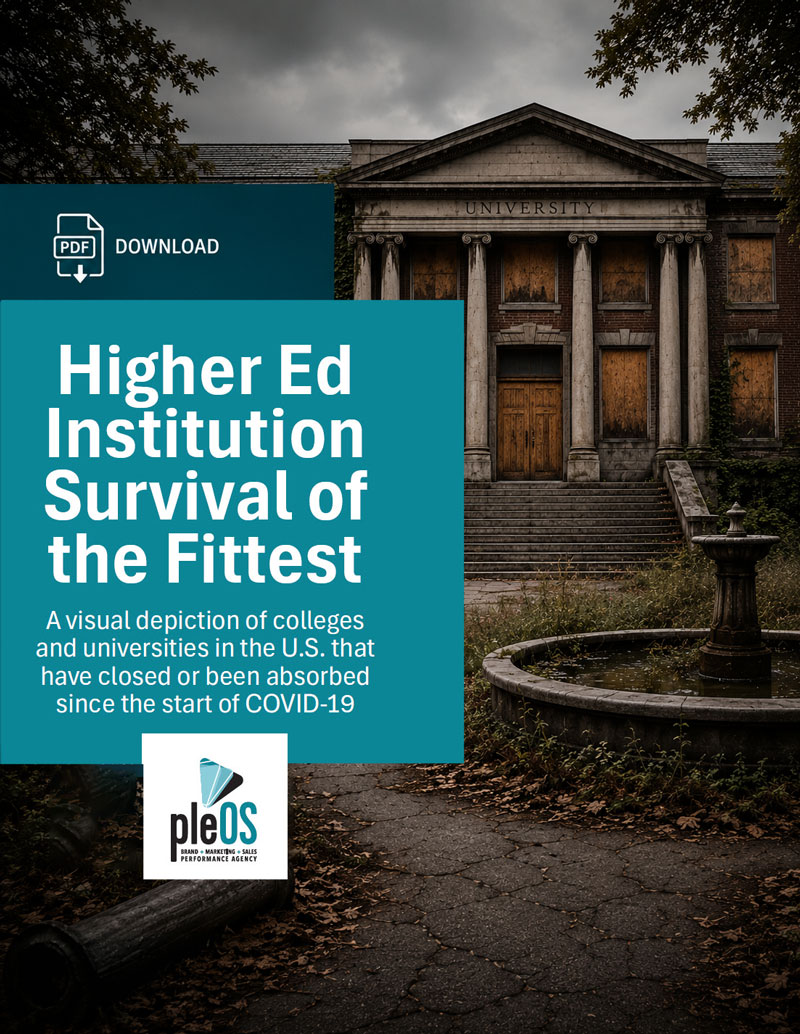
While worrying about falling behind is natural, it’s just as vital to look at new opportunities.
If you are responsible for enrollment, revenue, or long-term strategy, download this report:
How Rutgers University-Newark moved marketing beyond ‘apply here’

“In the first year of the campaign in 2024, we enrolled the largest incoming class in the university’s history.”
Contact pleOS


