

The college search no longer moves linearly through the traditional admissions journey.
AI is fundamentally changing how prospective students and parents discover, compare, and evaluate universities. As a result, how enrollment teams measure marketing performance must change, too.
The journey now starts earlier. Students spend more time exploring options through AI before they ever visit a university website. Visibility into their decision-making process is lower. Decisions happen faster. More of the process occurs outside your control.
While these changes are disruptive, they also create new opportunities. Universities that adapt their enrollment marketing strategies and measure success differently can earn a place on students’ shortlists long before an admissions counselor enters the conversation.
The traditional admissions journey is no longer relevant
For decades, enrollment marketing followed a predictable path. Students became aware of a university, researched programs, visited campus, applied, and ultimately enrolled. Universities largely controlled the information students received through websites, brochures, recruiters, college fairs, and campus visits.
Traditional journey
Awareness → Consideration → Application → Enrollment
Success depended on attracting attention, telling a compelling story, and guiding students through each stage of the admissions process.
Today, that journey looks very different.
A new AI-driven algorithmic journey
Students increasingly begin their search by asking AI broad questions rather than searching for specific universities.
Instead of asking, “Tell me about University X,” they ask:
- What colleges have the best cybersecurity programs?
- Which universities offer strong internships near Washington, D.C.?
- What schools are best for first-generation students?
- Which MBA programs have the highest return on investment?
AI gathers information from hundreds of sources, compares institutions, summarizes strengths, and recommends schools before students ever reach an admissions website.
New journey:
Questioning → Discovery → Validation → Considerationà Application
Let’s look at each step:
Questioning
Everything begins with questions. Universities must understand exactly what prospective students, parents, counselors, and graduate applicants are asking and create content that directly answers those questions.
Discovery
AI searches across university websites, rankings, news stories, faculty research, student outcomes, reviews, and third-party sources to identify institutions that match a student’s interests and goals.
Validation
AI evaluates which universities deserve a place on the student’s shortlist based on factors such as academic reputation, program strength, student outcomes, affordability, location, support services, and credibility.
Consideration
Students take a closer look at the universities AI recommends. They visit websites, attend virtual events, schedule campus tours, engage with admissions counselors, and compare financial aid packages. Human interaction becomes important again.
Application
Only after extensive AI-assisted research do many students submit applications, often to a smaller, more targeted list of schools.
New metrics for AI-driven admissions marketing
Traditional admissions metrics remain important, but they no longer tell the whole story. Universities also need visibility into how well they perform during AI discovery, when many decisions are already taking shape.
In addition to traditional metrics, consider tracking:
- Content engagement depth
- Return visitor rate
- Campus visit conversion rate
- Inquiry-to-application conversion
- Application-to-enrollment yield
- Student review volume and sentiment
- AI citation rate (how often AI tools reference your university)
- Inclusion rate in AI-generated college recommendations
- Share of voice in AI responses
- Content accessibility score (crawlable, structured, machine-readable)
- Branded versus non-branded AI mentions
- Topical authority for priority academic programs
- Competitive displacement rate (how often your university appears instead of competing institutions)
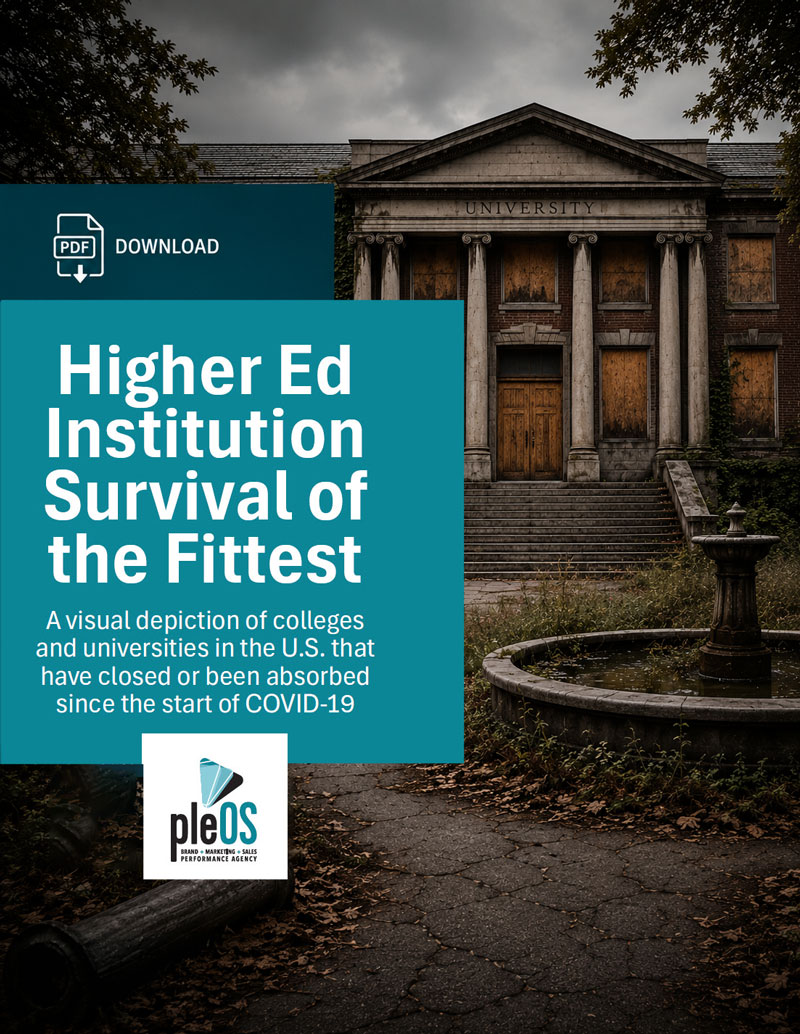
While worrying about falling behind is natural, it’s just as vital to look at new opportunities.
If you are responsible for enrollment, revenue, or long-term strategy, download this report:
Losing control of the process, but gaining influence
The days of controlling every step of the admissions journey are ending. Students have unprecedented access to information, and AI increasingly acts as the first advisor they consult.
That shift can feel unsettling, but it also creates new opportunities.
Universities that build authoritative content, clearly communicate their strengths, and optimize for both AI systems and human audiences can influence student decisions long before an application begins. The institutions that succeed will be those that become trusted sources for both machines and people, earning visibility early in the search process and remaining credible throughout the admissions journey.
Contact pleOS


